
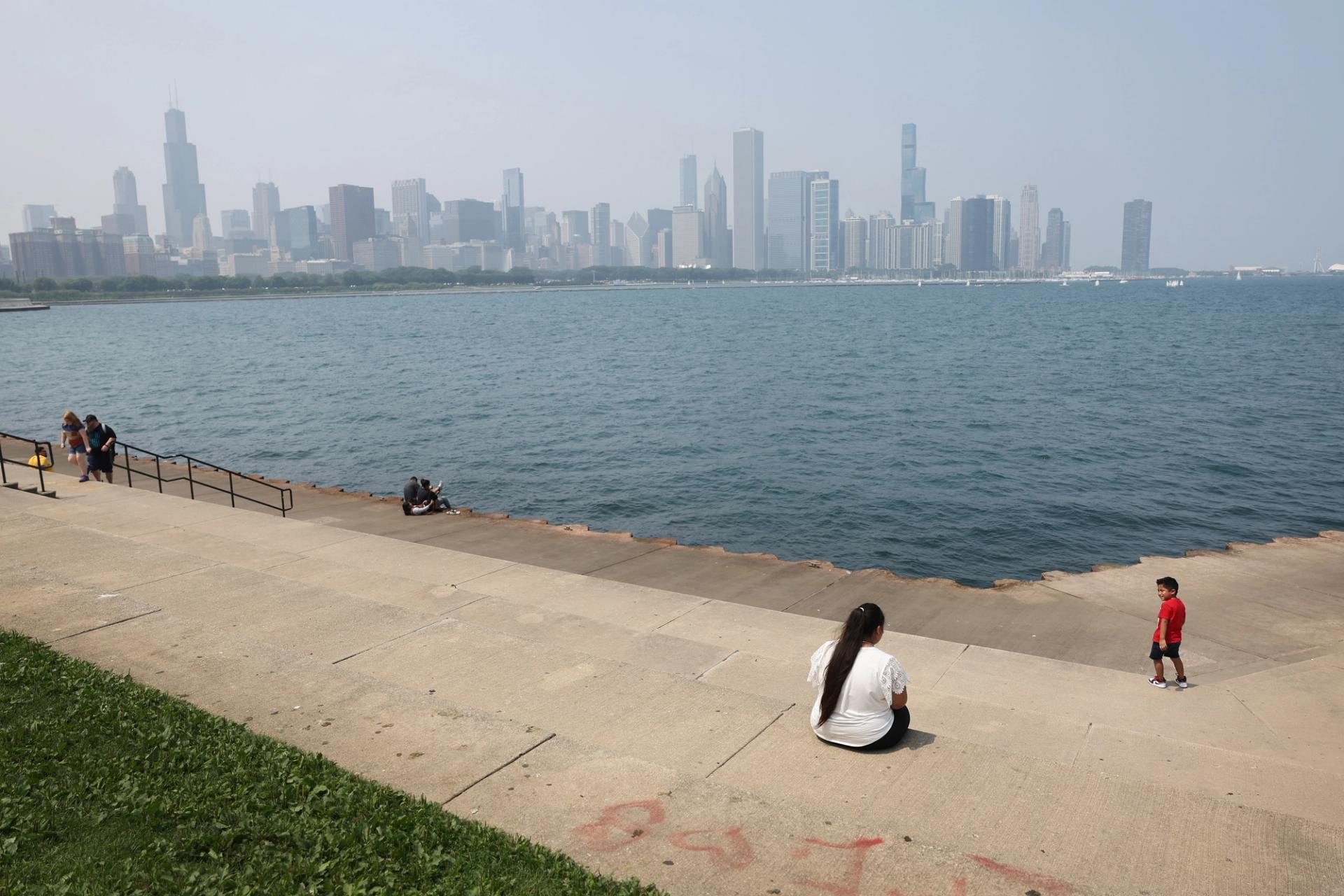
As Canadian wildfires rage on, smoke has moved across parts of the Midwest, triggering air quality alerts. While Illinois hasn’t received any yet, the sky was visibly hazy on Friday. On Monday morning, the sunrise was eerily red, also due to smoke.
So, generally, how is the air quality in Chicago?
State climatologist and University of Illinois researcher Trent Ford recently broke it down for City Cast Chicago.
This interview has been edited for length and clarity.
What exactly is the air quality index and what’s normal for Chicago?
Air quality index (AQI) is the Environmental Protection Agency’s (EPA) index that brings together multiple forms of pollutants in the air. It includes particulate matter, nitrogen dioxide, and ozone.
Typically in Chicago, especially this time of the year when we have a lot of mixing in the atmosphere, most days are in the green: an AQI level of zero to 50.
What is ‘mixing’ in the atmosphere?
Imagine you have a gallon of bleach. If you pour that bleach in your kiddie pool, that's gonna be a problem. If you pour it in Lake Michigan — you shouldn't do that — it's less of a problem because you're diluting. It's not necessarily the presence of pollutants that harms us physically. It's the concentration.
Pollutants can, what we call, mix throughout the atmosphere. They either go up vertically (if you think of the atmosphere like a column) or horizontally, blown to Indiana or wherever else.
That’s why certain cities have more air quality problems. Not just because they have more pollution, but because their conditions are conducive to keep pollutants there. They can’t mix well.
When is air quality poorer in Chicago?
In the winter because of the stable environment. And then in the summer during periods of high pressure. High pressure means air is sinking from the top of the atmosphere to the surface. That sinking motion stops pollutants from rising and mixing. Pretty warm summer days without much of a breeze in Chicago: Those are high-pressure days.
How is the future of Chicago's air quality looking as we think about climate change?
In one sense, moving away from coal-fired power plants improves air quality, especially when we offload that energy supply to solar, wind, and nuclear. A major benefit is very little air pollution. Illinois is a leader in nuclear, so that puts us at an advantage. More electric vehicles on the road will also greatly improve local, neighborhood-scale air quality.
On the downside, increased wildfire activity means we’ll likely see more brief, poor-air-quality periods because of smoke.
There’s also issues with heat. Warmer summers mean higher ozone pollution. And warmer winters in Chicago sound great, but that means we have a longer period of pollen release from trees and plants. We may not think of pollen as a pollutant, but if you have allergies, it definitely is because it ruins your day.
We want the best air quality information so that we know when to expect those potentially hazardous situations.